
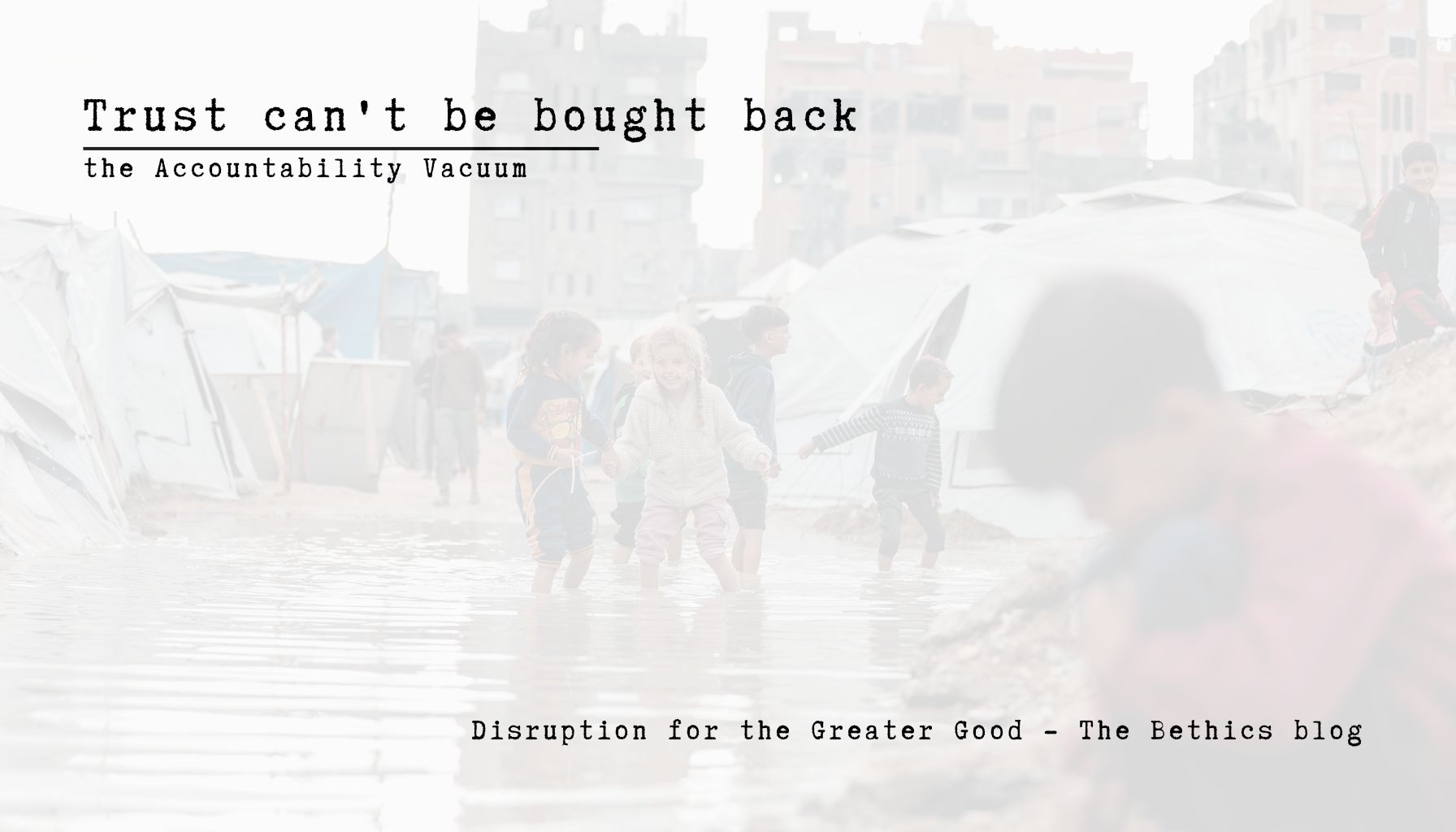
Soft Power and the Accountability Vacuum
Governments can rebuild budgets and reopen institutions. Rebuilding trust is far more difficult.
Diplomacy is often reduced to speeches and summits. Its greatest asset, however, is institutional memory. Career diplomats spend decades learning which local organizations are credible, which political actors can quietly resolve crises, and which warning signs rarely appear in official reporting. That knowledge cannot be recreated simply by hiring new staff.
The recent restructuring of U.S. foreign assistance illustrates this problem. In 2025, the Trump administration began reducing foreign aid and diplomatic programs on a large scale. Domestic cuts to social and humanitarian programs understandably attracted much of the political attention within the United States. Internationally, however, the deeper consequences may come from dismantling the institutions through which the United States has exercised diplomacy, development cooperation, and democratic engagement.
PEPFAR, the U.S. President’s Emergency Plan for AIDS Relief, demonstrates what these decisions mean in human terms. Since its creation in 2003, the program has been credited with saving more than 20 million lives. By mid-2025, roughly two-thirds of its USAID-administered awards had been terminated. An estimated 2.3 million people lost access to lifesaving treatment, more than 1,700 clinics closed, and over 16,000 health workers lost their jobs. Proposed budget reductions for FY2026 would cut the program’s core funding by nearly another forty percent. The human cost is already measurable.
PEPFAR is only one example. USAID has been largely dismantled. Democracy promotion, governance programming, civil society assistance, educational exchange, and human rights initiatives have all been reduced, suspended, or eliminated. Together, these changes raise a broader question. What values are reflected when governments conclude that institutions built around long-term relationships, international cooperation, and accountability are expendable?
Budgets are never simply accounting exercises. They are statements of political priorities. Every institutional reform expresses assumptions about what government should do, what kinds of problems deserve attention, and what forms of power are worth investing in. The cuts described above target institutions that create accountability through relationships rather than coercion.
Diplomacy is institutional memory
Experienced diplomats know which civil society organizations genuinely represent communities, and which merely claim to do so. They understand informal political relationships that never appear in official reporting. They recognize tensions long before they become crises. Perhaps most importantly, they know who can quietly solve problems before they require public intervention.
For decades, American diplomatic engagement included election observation, judicial reform, anti-corruption initiatives, partnerships with universities, support for independent media, assistance to civil society organizations, documentation of human rights abuses, and governance programs designed to strengthen the rule of law. These activities were often politically controversial. They were also built on the belief that accountable institutions reduce conflict, strengthen societies, and create more stable international partnerships.
Recent reductions have disproportionately affected precisely these areas. Whether viewed as ideological, strategic, or budgetary, the practical effect is the same: the institutional infrastructure through which accountability has traditionally been promoted is shrinking.
Institutions are frozen expressions of political values. The institutions governments choose to preserve, reform, or dismantle reveal the kind of power they believe matters most.
Vacuums do not remain empty
Political vacuums rarely remain vacant. The withdrawal of one country’s diplomats, development agencies, and civil society partnerships does not produce a world with less foreign influence. It produces a world shaped by different forms of influence.
As American assistance has receded, Russian grain shipments have begun arriving in African ports once supplied through U.S. food aid, while Chinese agricultural delegations have expanded their presence across the continent. South Africa, home to the world’s largest HIV epidemic and until recently one of the largest recipients of American HIV assistance, illustrates the shift. After U.S. funding was reduced, China contributed $3.5 million to HIV programs. The amount was modest, but the geopolitical signal was significant.
Foreign assistance has never been purely altruistic. It has always been an instrument of soft power. What is changing is not whether aid serves national interests, but what those interests are understood to require.
For decades, American development policy, despite its many inconsistencies and shortcomings, rested on the belief that stable, accountable institutions, independent civil society, and the rule of law ultimately produced a safer and more predictable international system. China’s and Russia’s approaches generally place less emphasis on governance conditions and democratic institutions, focusing instead on state-to-state partnerships and strategic alignment.
Influence follows presence. When one model of engagement retreats, another becomes relatively stronger. Governments adapt to the incentives surrounding them, and those incentives help shape the institutions that survive.
A changing understanding of power
A core question that now needs to be asked is why institutions built around diplomacy, educational exchange, civil society, governance, and long-term cooperation are increasingly being dismantled rather than reformed. The answer may not lie in hidden motives or elaborate conspiracies. It may lie in a changing understanding of power.
The post-war international order was built on the assumption that military strength alone could not secure lasting influence. It needed to be supported by alliances, diplomacy, educational exchange, development cooperation, and institutions capable of building trust across generations.
A different worldview places greater emphasis on sovereignty, transactional relationships, immediate national interest, and hard power, while placing less value on international institution-building and long-term solidarity.
The United Kingdom has already redefined aid more explicitly around national interest. Norway, in its ongoing review of aid strategy, presents an even more revealing case. Unlike the major powers, Norway has never maintained a global sphere of influence through foreign assistance. Yet the current Vendepunkt process raises many of the same questions: should aid primarily reduce poverty, or should it increasingly serve Norwegian security and national interests?
These are different countries with different histories and different geopolitical positions. Yet the direction of change is strikingly similar. Across parts of the Western world, institutions built around international solidarity are increasingly being re-evaluated through the language of strategy, security and national interest.
The accountability vacuum
In my earlier article, “The Assault on Civil Society,” I argued that weakening civil society creates an accountability vacuum. The same dynamic applies to diplomacy. When governments dismantle the institutions through which they build relationships, support accountable governance, and engage internationally, they weaken the mechanisms through which influence is exercised and accountability is sustained.
As experienced diplomats retire, governance specialists disappear, educational exchanges shrink, and partnerships with civil society weaken, accountability becomes harder to sustain. The people and institutions that quietly connected governments, communities, and international partners begin to disappear.
These losses are difficult to measure because their greatest successes were always invisible. No budget document records the negotiation that never takes place because the trusted intermediary is no longer there. No balance sheet captures the corruption investigation that never begins because governance advisers have disappeared. No audit counts the conflict that might have been prevented by relationships patiently built over decades.
These are the benefits of diplomacy at its most effective. Success is measured not by the crises it resolves, but by the crises that never occur. The question, therefore, is not whether every aid program deserved to continue unchanged. Nor is it whether governments have the right to reform public institutions. The question is whether we fully understand what is being discarded.
Knowledge can be documented. Experience can be accumulated. Trust, however, can only be earned. And once that trust is allowed to disappear, it becomes the one resource that no government, regardless of its budget, can simply buy back.
This article is part of the Accountability Vacuum series. Explore the full series here.
AI Transparency Statement: I used ChatGPT, Claude, and Gemini for background research and editorial feedback. All concepts, structure, and final wording are my own, and all AI-assisted findings have been independently fact-checked.

Leave a Reply