
Privacy as Damage Control
On May 13, 2026, Meta announced a new WhatsApp privacy feature called Incognito Chat. Conversations with Meta AI would be temporary, disappear after the session ends, and run in isolated environments that Meta claims even its own staff cannot access.
Mark Zuckerberg described it as “a completely private way to interact with AI.”
The announcement sounded reassuring while also highlighting a broader transformation of WhatsApp itself. In a previous article for Bethics, I explored how Meta gradually reshaped an app once defined primarily by privacy and encrypted communication. Incognito Chat is best understood as the next stage of that transformation.
Why does WhatsApp suddenly need an “incognito” mode for AI conversations inside an app that users already believed was private?
The AI Was Already There
Meta AI did not arrive with Incognito Chat.
The assistant launched across the United States in 2024 and expanded into Europe in 2025. By the time this privacy feature was announced, Meta CEO Mark Zuckerberg claimed Meta AI had reached more than one billion monthly active users across the company’s apps.
Meta inserted the assistant directly into WhatsApp’s interface. It appears in the search bar, inside chats, and throughout the app experience. Users can avoid interacting with it, but there is no meaningful way to remove it entirely.
That matters because WhatsApp is not just another social media platform. In Mexico, over 74 million people use it, close to universal among smartphone users. In Kenya, Nigeria, and South Africa, the figure exceeds 95% of internet users. For much of the world, it functions more like a phone network than a social media app. It is the channel through which families maintain cross-border relationships, small businesses operate, and people discuss medical issues, legal matters, and private family life.
The trust users place in WhatsApp is fundamentally different from the trust they place in Facebook or Instagram.
What Doesn’t Change
Incognito Chat does not change the underlying business model behind Meta AI.
Outside Incognito mode, conversations with the assistant are processed on Meta’s systems and used to improve AI products. Meta has confirmed that conversations with Meta AI can be used to personalize ads and recommendations across its platforms.
Some users can object to parts of this processing under legal frameworks such as the GDPR. For most users globally, however, conversations with an AI assistant inside a trusted messaging platform become part of Meta’s broader commercial ecosystem.
The Opt-Out Is Designed to Be Difficult
Even where legal rights exist, exercising them is intentionally cumbersome.
Users must navigate through multiple menus, forms, and policy layers to locate objection mechanisms. This reflects a broader industry pattern: privacy-protective choices are made harder than data-sharing defaults.
Most people will never look for the settings at all.
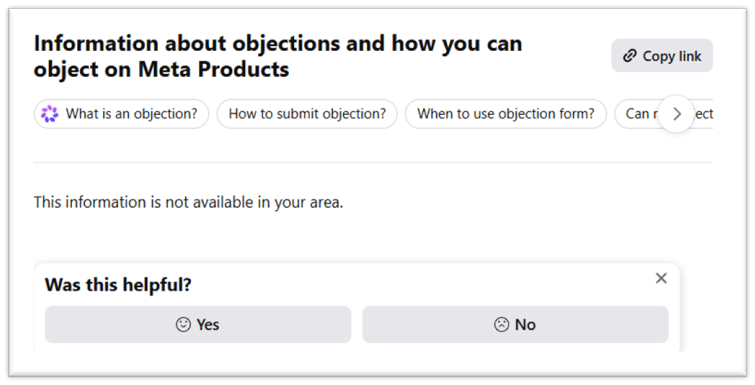
While researching this article from Mexico, Meta’s objection process appeared inaccessible despite Mexico having its own privacy legislation. The weak enforcement leaves users with far fewer practical protections against companies like Meta. Given Meta’s scale and legal resources, the company is unlikely to be unaware of Mexico’s privacy legislation. The unequal privacy protections offered across jurisdictions instead suggest compliance is driven more by enforcement pressure than by consistent privacy standards.
The default remains firmly in Meta’s favor.
The issue is therefore not only privacy, but inequality in privacy enforcement. Whether users can meaningfully resist data extraction increasingly depends on where they live.
What Incognito Chat Actually Does
To be clear, Incognito Chat may well represent a genuine technical improvement.
For highly sensitive questions, temporary AI sessions and isolated processing environments could provide meaningful additional protections.
But the feature only applies when users deliberately activate it. It does nothing to change ordinary interactions with Meta AI throughout the standard WhatsApp interface: search prompts, suggested replies, assistant conversations, or AI integrations inside group chats. Those interactions remain governed by Meta’s standard data policies.
The More Honest Version
WhatsApp still encrypts messages between people. That has not changed.
What has changed is that Meta embedded an AI system into one of the world’s most trusted communication platforms, enabled it by default, and connected it to a commercial ecosystem built around data collection and behavioral analysis.
A more honest announcement might have sounded something like this:
We added an AI assistant to your messaging app. Interactions with it may contribute to Meta’s AI and advertising systems. Some users can object because local laws require it. Most users globally cannot.
Incognito Chat is, fundamentally, a privacy solution to a privacy problem Meta created itself.
AI Transparency Statement: The author defined the core concepts, direction, and arguments for this article. AI tools, including ChatGPT and Claude, assisted with editing, drafting, and research. All content was reviewed, verified, and finalized by the author.